

VRV-VRF Installation
VRV/VRF Installation Service
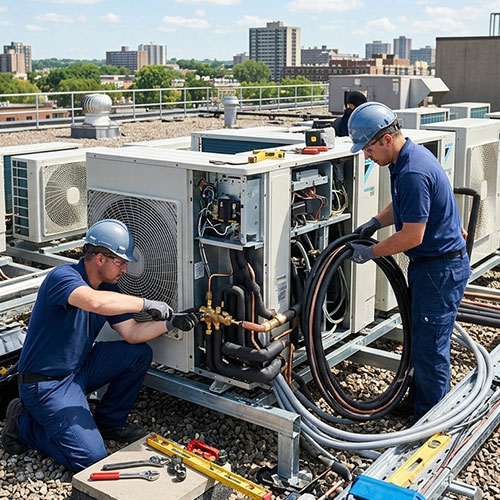
VRV and VRF air-conditioning systems are designed for buildings that require centralized refrigerant-based cooling with multiple indoor units operating from one or more outdoor units. These systems allow different areas of a building to be conditioned according to individual requirements and are widely used in offices, hotels, commercial buildings, retail spaces and other large properties.Artic Refrigerator provides VRV/VRF Installation Service in Kolkata, Howrah, Haldia, Durgapur, Asansol, Patna, Bihar, Ranchi and Hooghly, with installation planned around the building layout, cooling requirements, indoor-unit locations and system configuration.
Planning the Right VRV/VRF System
A successful VRV/VRF installation begins before the equipment reaches the site. The building needs to be evaluated so that the system can be configured according to its actual cooling requirements.
Important considerations include:
- Building size and layout
- Number of rooms or zones
- Required cooling capacity
- Occupancy levels
- Heat-generating equipment
- Indoor unit positions
- Outdoor unit location
- Refrigerant piping route
- Drainage arrangement
- Electrical supply
- Access for future servicing
This planning stage helps establish an installation layout that is suitable for the building rather than using a one-size-fits-all configuration.
VRV/VRF Installation Service: What We Handle
Artic Refrigerator can support different stages of VRV/VRF installation, including:
- Site Assessment
The available space, building layout and installation conditions are reviewed before the system setup.
- Indoor Unit Positioning
Indoor units are positioned according to room usage, airflow requirements and architectural limitations.
- Outdoor Unit Placement
Outdoor units require appropriate clearance for airflow, heat rejection and future maintenance access.
- Refrigerant Piping
The refrigerant pipe network connects the outdoor unit with the indoor units. Correct routing, joining, insulation and installation practices are essential.
- Drainage Arrangement
Condensate generated by indoor units must be directed through a suitable drainage system.
- Electrical & Control Connections
Power and communication connections are arranged according to the equipment configuration and manufacturer’s requirements.
- System Commissioning
After installation, the system is checked and tested before being placed into normal operation.
Important Components in a VRV/VRF System
A typical VRV/VRF installation may include:
- Outdoor condensing units
- Multiple indoor units
- Refrigerant piping
- Branch joints or refrigerant distribution components
- Drain piping
- Insulation
- Wired or wireless controllers
- Centralized control systems, where required
- Electrical cabling
- Communication wiring
- Mounting and support arrangements
The exact components depend on the selected manufacturer, system capacity and building configuration.
Technical Points That Matter During Installation
VRV/VRF systems require careful attention to installation parameters. Important technical considerations can include:
| Installation Parameter | Importance |
| Cooling Capacity | Determines whether the system can meet the building load |
| Indoor Unit Count | Defines the number of independently conditioned spaces |
| Refrigerant Pipe Length | Must remain within manufacturer-specified limits |
| Vertical Separation | Affects permissible system configuration |
| Pipe Insulation | Helps control heat gain and condensation |
| Drainage Slope | Supports proper condensate removal |
| Outdoor Clearance | Allows suitable heat rejection and service access |
| Electrical Supply | Must match equipment requirements |
| Communication Wiring | Enables coordination between system components |
| Commissioning | Confirms correct operation after installation |
Exact allowable pipe lengths, height differences, connection ratios and electrical specifications vary by manufacturer and model.
Why VRV/VRF Installation Requires Specialized Planning
Unlike a basic single-room air conditioner, a VRV/VRF system can serve multiple zones through a connected refrigerant network. Installation errors in piping, insulation, drainage, electrical connections or system configuration can affect overall operation.
Professional installation helps address:
- Correct refrigerant distribution
- Suitable indoor-unit placement
- Proper drainage
- Effective airflow
- System communication
- Outdoor-unit accessibility
- Future maintenance requirements
VRV/VRF for Multi-Zone Cooling
One of the major uses of VRV/VRF technology is the ability to divide a building into different cooling zones.
For example, an office may require separate temperature control for:
- Reception
- Meeting rooms
- Individual cabins
- Workstations
- Conference rooms
- Server or equipment areas, where appropriately designed
- Administrative sections
Different areas can therefore be planned around their individual occupancy and cooling requirements.
Where VRV/VRF Systems Are Commonly Installed
VRV/VRF systems are particularly relevant to:
- Corporate offices
- Hotels
- Commercial buildings
- Shopping and retail spaces
- Showrooms
- Restaurants
- Hospitals and healthcare facilities
- Educational buildings
- Banks
- Large residences
- Business centres
- Institutional buildings
Artic Refrigerator provides installation support acrossKolkata, Howrah, Haldia, Durgapur, Asansol, Patna, Bihar, Ranchi and Hooghly, subject to project requirements.
VRV vs VRF: Are They Different Systems?
VRV and VRF generally refer to the same broad type of variable-refrigerant-flow air-conditioning technology. VRV is a trademarked term associated with Daikin, while VRF is the generic term commonly used for similar systems from different manufacturers.
The actual equipment configuration and features depend on the selected brand and model.
VRV/VRF Installation for New & Existing Buildings
A VRV/VRF system can be considered during new construction as well as certain renovation or HVAC replacement projects.
For a new building, the refrigerant piping, drainage, electrical provisions and indoor-unit locations can be coordinated during the design stage.
For an existing building, the installation needs to account for:
- Existing ceilings
- Available service shafts
- Structural limitations
- Existing electrical infrastructure
- New piping routes
- Drainage possibilities
- Occupied areas
- Access restrictions
This makes a site assessment particularly important before finalizing the installation plan.
Commissioning After VRV/VRF Installation
Installation is not complete simply because all equipment has been physically connected. Commissioning helps verify that the installed system is ready for operation.
Depending on the equipment, commissioning may involve:
- Connection verification
- Refrigerant-system checks
- Drainage testing
- Electrical inspection
- Communication-system checking
- Indoor-unit operation testing
- Outdoor-unit operation testing
- Controller verification
- Cooling-performance assessment
The commissioning procedure should follow the relevant manufacturer’s installation and operating requirements.
Why Choose Artic Refrigerator for VRV/VRF Installation?
Artic Refrigerator approaches VRV/VRF installation as a complete system project rather than simply placing AC units at different locations.
Our service focuses on:
- Site-specific planning
- Multi-zone installation
- Indoor and outdoor unit coordination
- Refrigerant piping support
- Drainage planning
- Electrical and control coordination
- Installation testing
- Commissioning support
- Commercial and residential project requirements
For projects in Kolkata and Howrah, as well as Haldia, Durgapur, Asansol, Patna, Bihar, Ranchi and Hooghly, installation requirements can be evaluated according to the building design and proposed system.
Customer Queries
What is a VRV/VRF air-conditioning system?
It is a multi-zone air-conditioning system that uses variable refrigerant flow to provide cooling to multiple indoor units connected to outdoor equipment.
Is VRV/VRF suitable for offices?
Yes. VRV/VRF systems are commonly considered for offices because different rooms and zones can have individual indoor units and control requirements.
Does VRV/VRF installation require refrigerant piping?
Yes. The indoor and outdoor units are connected through a refrigerant piping network designed according to the selected system and manufacturer’s limits.
Can VRV/VRF be installed in an existing building?
It can be possible, but feasibility depends on available space, piping routes, electrical infrastructure, drainage, ceiling arrangements and other site conditions.
How long does VRV/VRF installation take?
Installation time depends on the building size, number of indoor units, piping complexity, site readiness and system configuration. A project-specific assessment is required for an accurate schedule.
Is VRV the same as VRF?
VRV and VRF describe essentially the same type of variable-refrigerant-flow technology. VRV is a trademarked term, while VRF is the generic terminology used across the industry.
Where does Artic Refrigerator provide VRV/VRF installation service?
Artic Refrigerator provides VRV/VRF Installation Service in Kolkata, Howrah, Haldia, Durgapur, Asansol, Patna, Bihar, Ranchi and Hooghly, depending on project requirements and service availability.
Contact Artic Refrigerator for VRV/VRF Installation
Planning a new commercial HVAC system or upgrading an existing air-conditioning arrangement? Contact Artic Refrigerator for VRV/VRF Installation Service and discuss your building layout, cooling requirements, number of zones and project location. A site-specific assessment can help determine the appropriate installation approach.